
Growing Solidarity
Newsletter for the Second and Third Week of May

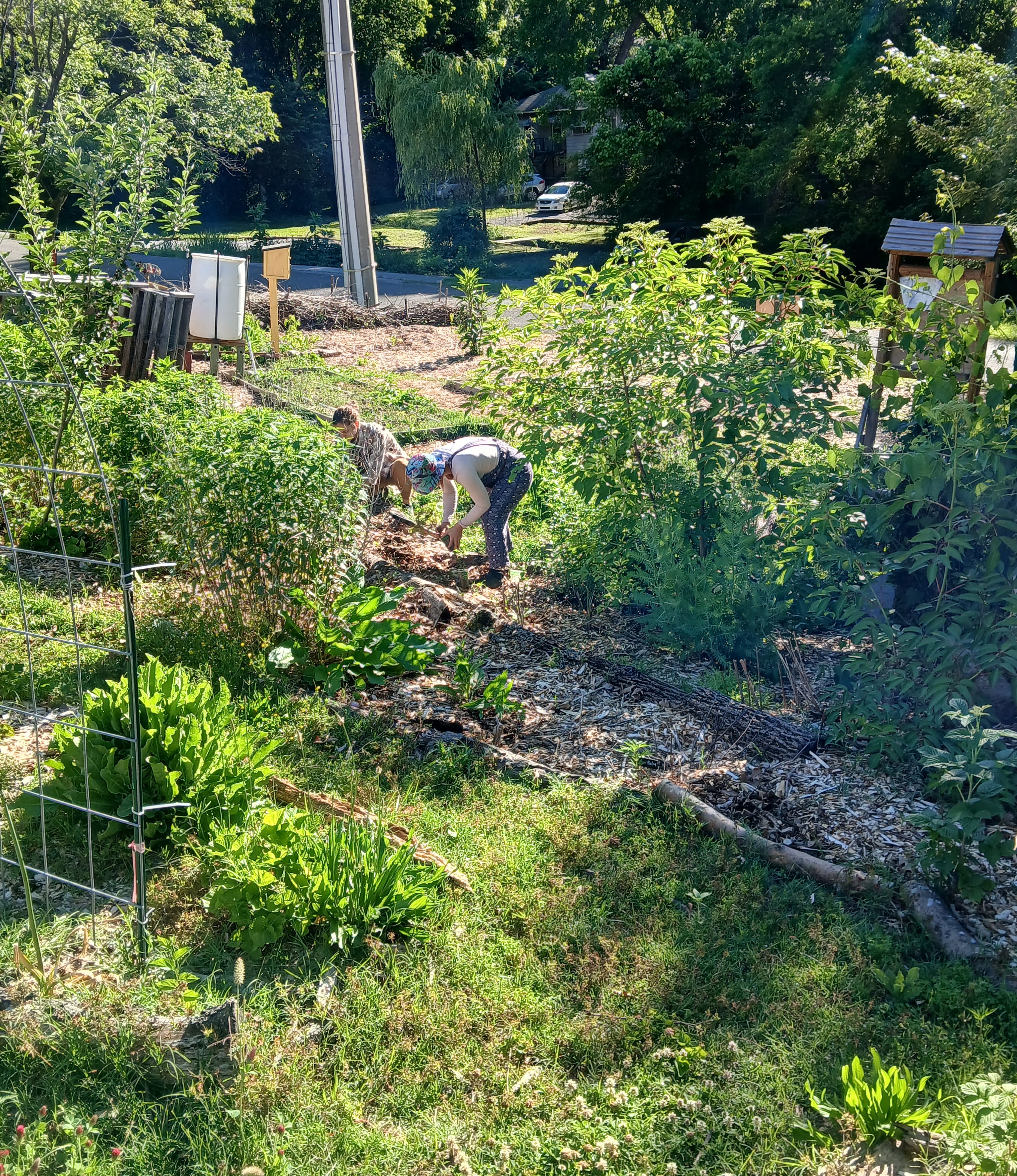
Tuesday morning I stopped by the St. Elmo Community Food Forest for a few minutes to cut the paths—the scarlet clover we planted last fall in several of the pathways had reached senescence and were ready to be chopped and dropped. Next to the food forest is a play-space that is quite popular with children passing by on the greenway, and yesterday morning it was pretty busy. After cutting the paths I invited the parents and children up to sample the ripened fruit that is now coming in—strawberries, blackberries, and raspberries—and talk a bit about the space. As an aside, one of the challenges we’ve encountered in doing this work is making sure that people feel authorized to use these spaces, to feel free to forage and explore, to interact with the space in ways that are usually forbidden or discouraged in other public spaces. The best way to do this kind of encouragement and teaching is face-to-face; the second best is through adequate signage, and on the latter front we’re still figuring what works and how.
While showing the families present around one little boy got very excited about picking and eating strawberries, also sampling with equal enthusiasm the mock strawberries (Potentilla indica) that have volunteered most heavily in the muscadine bed. I assured his mom that it was perfectly fine for him to step off the path and forage in the forest garden bed, the plants all hardy perennials that, honestly, are hard to kill even if you want to do so. Not only do such plants and growing spaces invite exploration, they do so in multiple registers: touch, smell, sight, taste, and because they are multilayered open themselves up to different people in different ways. In the case of low-growing fruit producers and herbs, the perspective of a small child—comfortably closer to the ground than us grown-ups—will tend to elicit a richer and more productive encounter than those of us whose heads are higher up in the fruit tree branches can enjoy.
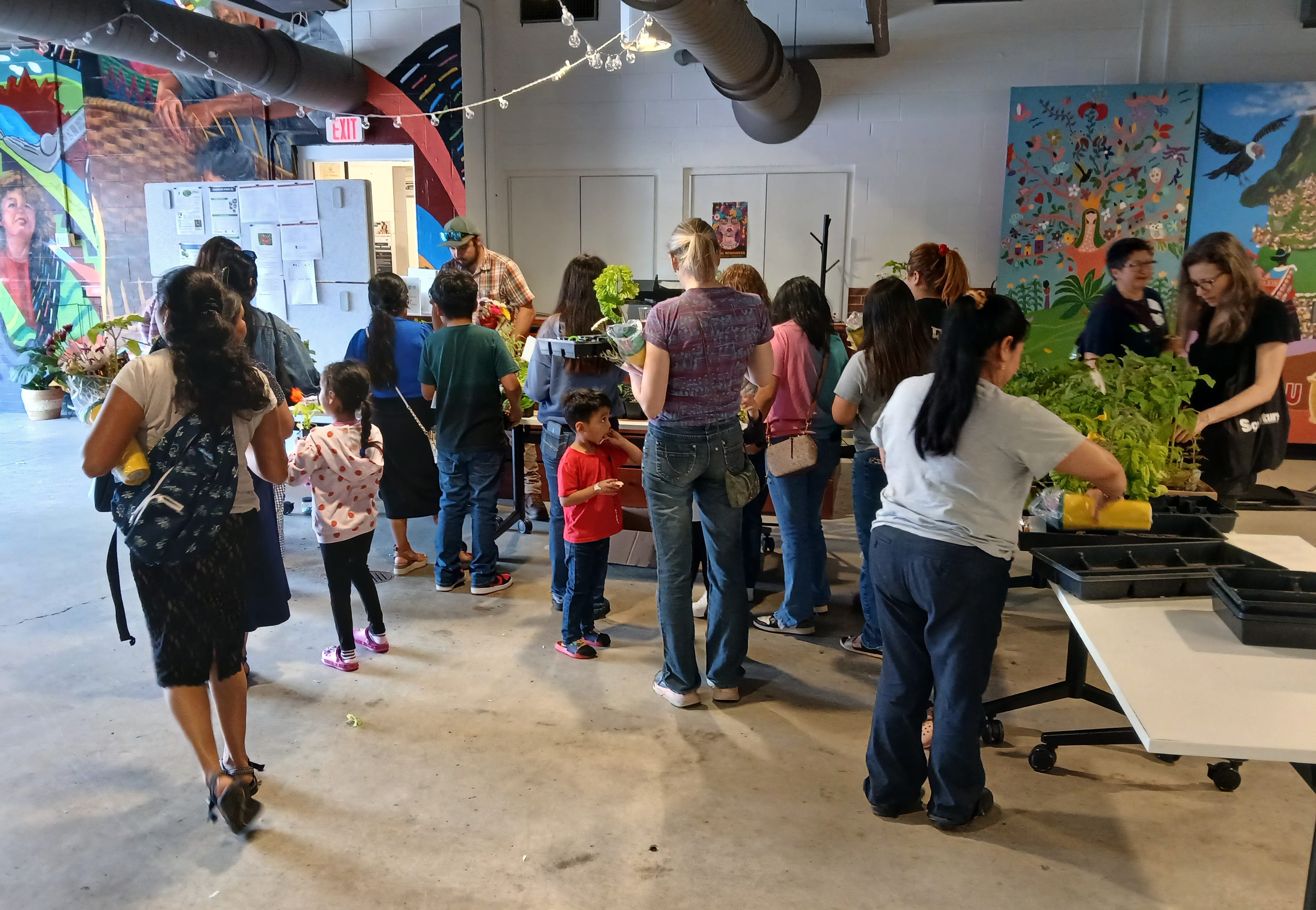
On the Saturday before Mother’s Day we helped host a plant give-away at La Paz Chattanooga, featuring plants brought by neighbors, plants I’d started in my home seed-starting space, and several trays from Crabtree Farms which they’d set aside after their spring plant sale for public distribution; an hour or so in Damon at the Farm at the Beth sent over a bunch of strawberry plants. Along with the plant distribution there were activities for kids, bouquets of flowers for the moms in attendance, pot painting and planting out by the new community garden beds. My daughter set up a face painting station in the patio area of La Paz. We had not been really sure how many people would attend—with any event geared towards our migrant communities there is always the chance that fear of deportation agents will keep people home and away from public gatherings, but fortunately things passed without incident. My Spanish-language skills are not what they once were, and at least once on Saturday to my chagrin mixed Arabic (my “first” second language) with Spanish. Fortunately there were plenty of people on hand to answer, in much better Spanish, questions about the plants on hand, and by the end of the event all had gone off to new homes to be planted and enjoyed.
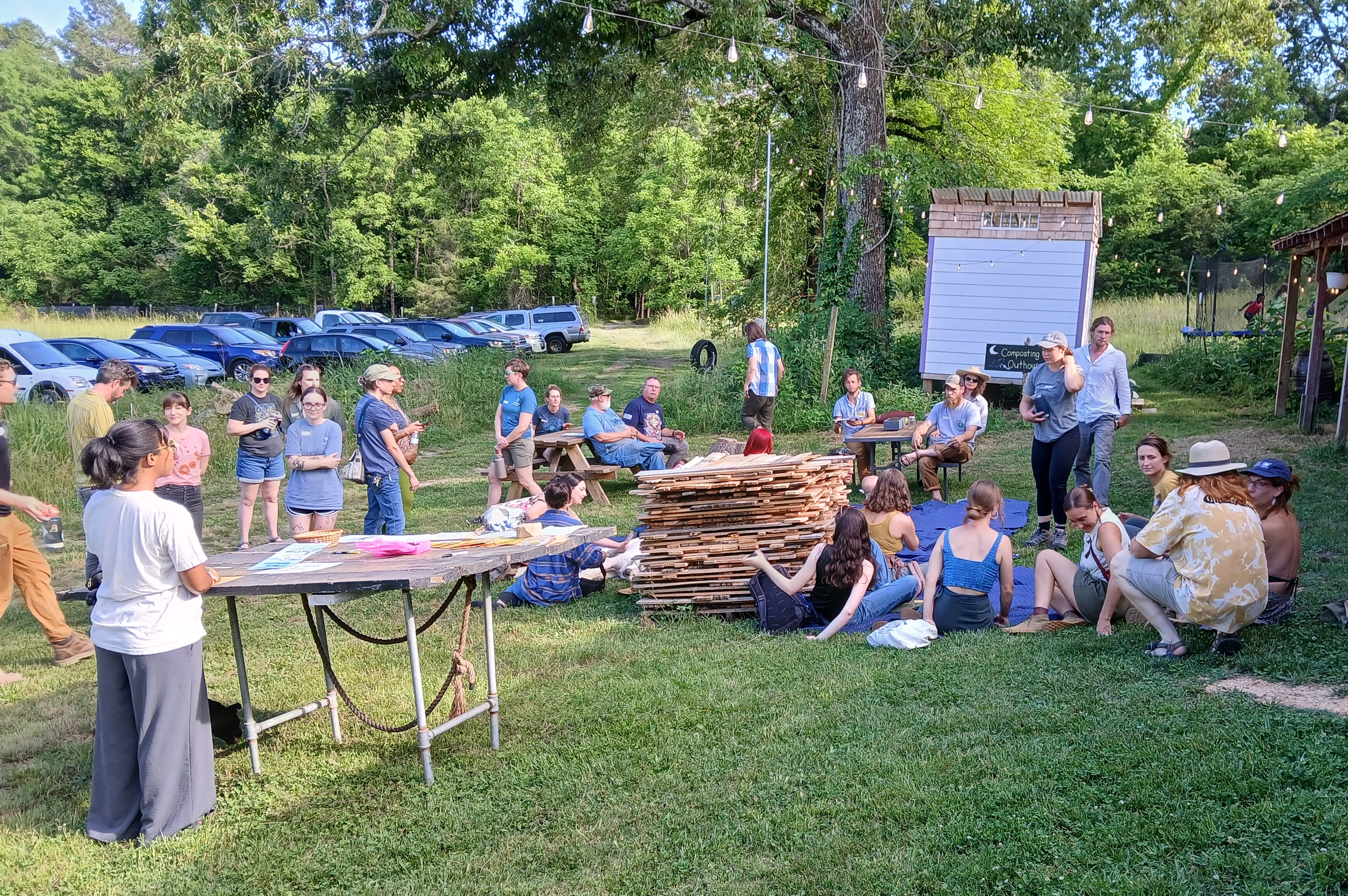
On Tuesday evening of this week we, along with a handful of other local organizations, hosted the spring session of the Chattanooga urban agriculture roundtable, a quarterly gathering and affiliation group that has been slowly evolving into…something, not another organization but something less solid and more open, meant at heart to bring people doing broadly similar kinds of community-oriented agroecological work (not that everyone would describe it as such) in and around Chattanooga. On Tuesday evening we gathered out in Walker County (peri-urban, technically) at Taylor MacDonald’s place, Death Farm Permaculture, and talked, ate, and listened to some local old time string musicians play. The kids ran around and jumped on Taylor’s trampoline or petted bunnies; visitors toured the farm grounds, saw all the new trees that have gone in lately as part of an agroforestry project. We had some semi-formal working group sessions and bounced around ideas, came up with some practical stuff to do, but mostly, we’re realizing, these gatherings work best as just that, gatherings to cultivate a sense of community and solidarity, to reassure everyone that we are not alone even as we face wider social and political odds that can seem pretty bleak indeed, but a little less so when in cheerful company with others.
Solidarity is a practice that works in all directions. It inculcates an awareness of the gifts of the other, of our mutual need for one another, no matter our status, wealth, conventional power in the world, and so on. It is not a naive exercise in wishful thinking, but rather a direction in which to move and to struggle, as often as not with our own impulses in relationship with others.
I have also found that solidarity is a concept that sounds really good and exciting in the abstract, but much like genuine democracy, with which the practice and ethic of solidarity is bound up, both are very hard to realize in the real world among real, complicated people. My deepest religious and political beliefs and commitments both put the fundamental solidarity of humankind, the irreducible dignity and worth of each human being, and rejection of coercive power over others at the heart of everything—and yet, perhaps unsurprisingly, I still struggle with carrying these things out in everyday life. Part of me very much wants to tell people what to do—for their own good of course!—and to have them accept my instructions and advice without question. That same part of me wants to manage and to hand down from on high, to be respected and appreciated to boot. And in some cases, sure, if people just did as I told them we’d have somewhat less work to do further down the line, or not—as loathe as I am to admit it, I make plenty of mistakes and my knowledge is very far from comprehensive. But that is somewhat beside the point: in the case of cultivating shared growing spaces, whether farm, garden, food forest, or whatever, as vital if not more vital is the cultivation of human personhood and agency and relationship. If we could, as may well be technically possible at some not too distant juncture, put robots to work pulling weeds and pruning trees we could probably boost raw productivity metrics. But we would lose the experience of working together, of working across boundaries of difference and division, of nurturing in our work human relationships and personalities and lives. Dictating to others cannot accomplish those things, nor can mere focus on productivity.
For this newsletter—which is running longer than I’d planned!—I’m going to combine a couple of features into one. Instead of one single species of plant, I’d like to draw your attention to a term for a plant assemblage, one that you may have already encountered, milpa, which comes to us via Spanish from the Nahuatl term mīllpan, a term that combines mīlli—”cultivated land”—and pan—“in, on.” The stress then is what grows on and in the space of what has long been the main crop of Mesoamerica, maize. Milpa, in its original sense, entails the whole system of growing various crops—beans and squash most famously (in North America, with maize making up the “three sisters”), but also a wide range of other possible crop plants and even trees. In parts of Mexico milpa has become shorthand for maize, the centerpiece of the milpa agroecosystem, the exact details of which vary from place to place in Mesoamerica.
You can learn a great deal more about the living tradition of milpa cultivation via a free online course offered by our organization of the week, Going To Seed, which focuses on supporting and encouraging what they call “adaptation gardening,” the agroecological practice of selecting, saving, and sharing seeds from local varieties as they adapt to particular conditions. If you attended the gathering Tuesday you may have seen or picked up one of their okra zines and seeds. Their online course, “Center of Origin: Traditional Farming Methods in Southern Mexico,”
showcases the homestead scale techniques and practices employed by peasant and indigenous families from the states of Guerrero and Oaxaca. Lessons include practical information on the selection and improvement of corn, squash, beans, tomatoes, chili peppers, and others.
The course will provide a theoretical understanding of the biocultural roots and significance of the milpa, along with practical information and insights. By the end of the course, participants will have a comprehensive understanding of the importance of the milpa, its cultural and historical significance, as well as practical information on how to create their own milpa in their backyard.
Do consider working through the course, especially if you have space to try out a “backyard milpa” yourself, but even if you don’t it is worthwhile, in no small part because backyard milpas cultivated by Central American migrants are fairly common already across Chattanooga, once you know a bit about them you will start to recognize them more often.
Finally, coming up next week:
On Tuesday, May 26, from 6 to 8 pm we will have the Chattanooga Food Forest Coalition Arts & Crafts Evening at And Then Books, 400 Spring Street, Rossville, GA; we’ll be painting signage for community growing spaces, working on zine design, and really whatever else folks want to do arts and crafts wise!
On Thursday, May 28, we will be helping revive a community garden at the Purpose Point Community Health Center; meet at 2806 Noa Street, Chattanooga, TN.
And as always weekly sessions continue at Chattanooga Valley, St. Elmo, and South Chattanooga; we're moving the Chattanooga Civic Center at Mountainside to once a month for now and will soon be adding new weekly sessions at the ELLA Library and at Ascension Lutheran, so stay tuned!